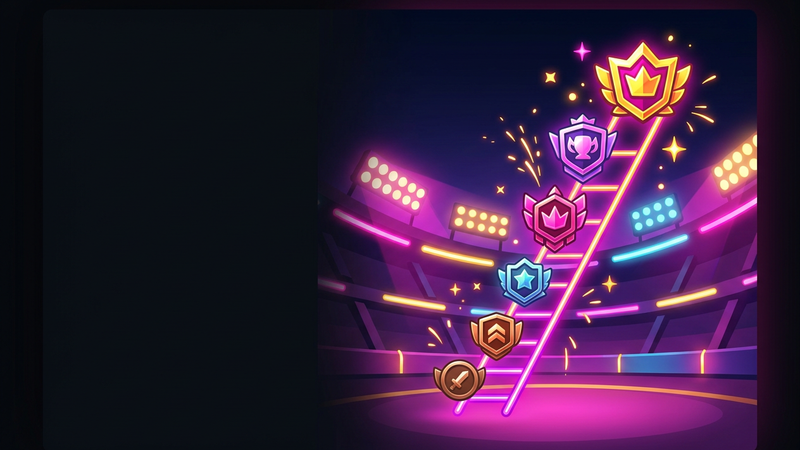
StarCraft II ranks players in seven leagues: Bronze, Silver, Gold, Platinum, Diamond, Master and Grandmaster. Every league below Grandmaster has three tiers. You are placed after five matches, and from then on your visible MMR decides your league. To climb, fix your macro first: constant workers, no supply blocks and spending your money.
This guide explains how leagues, tiers, MMR and Grandmaster work, then gives a simple plan to climb the 1v1 ladder. It is current as of October 2026. Check your own numbers on the RankSurge StarCraft II stats page as you go.
What are the StarCraft II leagues in order?
| League | Tiers | Notes |
|---|---|---|
| Bronze | 3 | Where most new ladder players start |
| Silver | 3 | Basic builds and steady worker production pay off here |
| Gold | 3 | Scouting and reacting to what you see start to matter |
| Platinum | 3 | Clean builds and timings separate players |
| Diamond | 3 | Strong macro under pressure |
| Master | 3 | The highest league you can be placed into |
| Grandmaster | None | The top 200 players per region |
There are seven leagues, and a Practice League that once existed for new players has been removed, per Liquipedia. Each mode keeps its own ladder, so your 1v1 league can be very different from your 2v2 or Archon league.
How do placements and MMR work?
You play five placement matches on a ladder before it puts you in a league. After placements, every game moves your MMR (matchmaking rating). Wins raise it and losses lower it, and results against stronger or weaker opponents move it more or less. Your league and tier simply follow your MMR.
- MMR is visible: StarCraft II has shown MMR to players since patch 3.4, so there is no hidden number behind your rank.
- Promotion follows the number: if your MMR rises into the next league's range, you are promoted. A crest that has not changed yet does not mean you are stuck.
- Each mode is separate: 1v1, 2v2, 3v3, 4v4 and Archon each have their own MMR.
Because the number is official, RankSurge shows the MMR Blizzard reports through the Battle.net API and never estimates one.
How does Grandmaster work?
Grandmaster is different from every other league. It opens one week after a season starts and holds the top 200 players in each region. Each day the lowest Grandmaster players drop back to Master and the best Master players are promoted to refill it, per Liquipedia.
- Activity rule: you must play at least 30 games every three weeks to keep your spot.
- No direct placement: placement matches can never put you straight into Grandmaster.
- Regional: Americas, Europe and Korea & Taiwan each have their own Grandmaster league.
The RankSurge StarCraft II hub shows the Grandmaster board for each region, so you can see the current cutoff before you push.
What should you fix first to climb?
Macro, short for macromanagement, is managing your economy: spending minerals and gas efficiently and avoiding supply blocks, per Liquipedia. It is the biggest lever for most players below Master.
- Never stop building workers: more workers raise your income, until one base is saturated. Liquipedia notes that efficiency drops sharply beyond about 22 workers on one base, so expand to keep growing.
- Stay ahead on supply: Pylons, Supply Depots and Overlords count as economy spending because a supply block stops all production.
- Spend your money: a large bank of unspent minerals is an army you did not build. Queue the next units as the last ones finish.
- Expand on time: a new base is how your economy keeps growing after the first one fills up.
How should you practice each week?
- One build per matchup: pick a standard opening for each opponent race and play it until you do not have to think about it.
- Review losses, not wins: watch the replay of each loss and find the first moment you fell behind, such as a supply block, a missed scout or a lost army.
- Play in blocks: a few focused games with a review beat a long session where mistakes repeat.
- Track one number: watch your MMR over a week instead of reacting to every single game.
Which mistakes keep players stuck in a league?
- Chasing new builds: switching openings every few games means you never learn the timings of any of them. Stick with one per matchup for a full week.
- Not scouting: if you do not know what your opponent is building, you cannot react. Send a worker or a unit to look at the right times in your build.
- Floating resources: a big pile of minerals in the middle of a fight means units you could have had. Glance at your bank between fights.
- Losing the army for nothing: fighting in the open or into a stronger position throws away the economy you built. Retreat when the fight is bad and defend at home.
- Tilt queuing: MMR moves with every game, so a long losing streak costs more than one bad game. Stop after two losses and watch the replays.
Most of these show up in your season record. A ladder or race where losses pile up is usually the place one of these habits is costing you games, which is why reviewing your record each week helps you choose what to practice.
It also helps to watch a replay of a player one league above you playing the same matchup. Compare when they build their second base and how many workers they have at set times, then copy one difference into your own games.
How can RankSurge help you climb?
Look up your profile on the StarCraft II stats page to see your league, rank, 1v1 MMR and season record for each ladder, then ask RankSurge AI which ladder to focus on. Compare yourself with a practice partner in AI Profile Pick, and keep your accounts together in the Player Hub. More guides for every game are in the Guide Library. RankSurge is not affiliated with Blizzard Entertainment.
Ask RankSurge AI about your profile. Paste your StarCraft II profile link on the StarCraft II stats page and ask what to fix first to reach the next league.
Frequently asked questions
What are the ranks in StarCraft II?
StarCraft II uses seven leagues on its ladder. From lowest to highest they are Bronze, Silver, Gold, Platinum, Diamond, Master and Grandmaster. Every league below Grandmaster is split into three tiers. Grandmaster is a single league holding the top 200 players in each region. Each mode, such as 1v1, 2v2, 3v3, 4v4 and Archon, has its own ladder with separate leagues.
How does MMR work in StarCraft II?
MMR, or matchmaking rating, is the number the ladder uses to match you against players of similar skill. Wins raise it and losses lower it, and beating a higher-rated opponent moves it more. Your league and tier follow your MMR. StarCraft II has shown MMR to players since patch 3.4, so you can see the exact number behind your rank in game and on RankSurge.
How many placement matches are there in StarCraft II?
You play five placement matches on a ladder before you are placed in a league. After that, every game moves your MMR and your league follows it. Placements cannot put you straight into Grandmaster, however well you do. If you are new, expect your first league to move quickly as the system learns your level over your first dozens of games.
How do you get Grandmaster in StarCraft II?
Reach the top of Master in your region and keep playing. Grandmaster opens one week after a season starts and holds the top 200 players per region. Each day the lowest Grandmaster players drop to Master and the best Master players are promoted to refill it. You must also play at least 30 games every three weeks to keep your place.
What is the fastest way to climb in StarCraft II?
Fix your macro before anything else. Build workers constantly, avoid supply blocks, spend your resources instead of banking them, and expand on time. Learn one standard build per matchup and play it until it is automatic, then watch your losses back to find the moment the game turned. Most players climb faster from these habits than from new strategies.
Can I check my StarCraft II league and MMR on RankSurge?
Yes. Paste your StarCraft II profile link on the RankSurge StarCraft II page, or sign in with Battle.net, to see your league, rank and 1v1 MMR, your season record and the Grandmaster board for your region. The data comes from the official Blizzard Battle.net API. You can also ask RankSurge AI about your numbers or compare two profiles in AI Profile Pick.